
A Cup Half Full
War Day 25

War
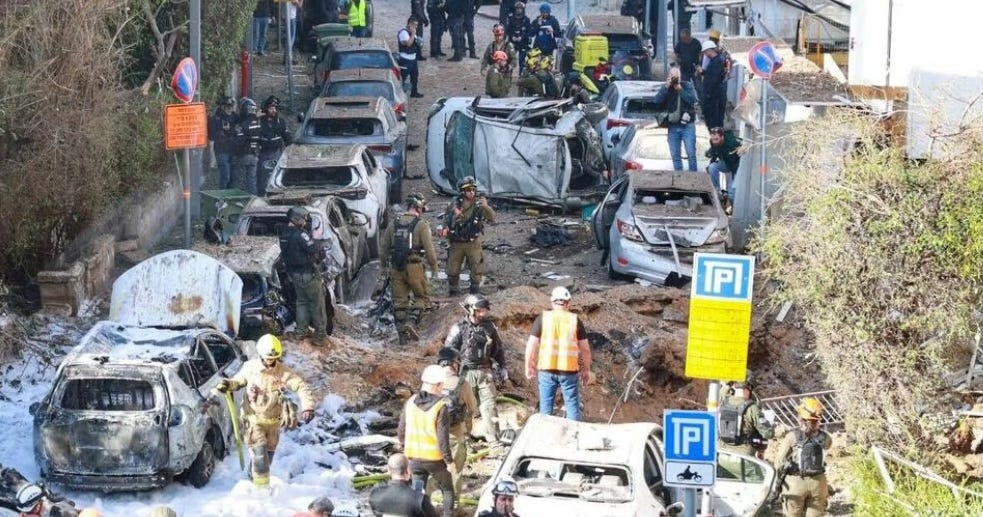
Iranian missile damage in Tel Aviv
Media reports peace talks between Iran and the US. According to Ronen Bergman, writing in the New York Times, US Special Envoy Steve Witkoff received a call on Thursday March 19th from Iranian Foreign Minister Araqchi.

Steve Witkoff (left) Iranian Foreign Minister Araqchi (right)
In the call that Witkoff took, with Jered Kushner beside him, he was reportedly standing up in a series of public public places and talking loudly, while he was told that Iran’s new Supreme Leader Mojtaba Khamenei had approved the talks.
Witkoff was also told that the Iranians were willing to give approximately what they agreed to give in Geneva the last time the teams came to negotiate before the war, and just as then, they are now ready to discuss the evacuation of highly enriched uranium to Russia, but not willing to give up on the ballistic missile issues, that is, not touching them at all, and not willing to completely remove enrichment from Iranian territory.
US President Trump said on Sunday, March 22nd, “We have had very, very strong talks. We’ll see where they lead. We have points, major points of agreement, I would say, almost all points of agreement... we’ve had very strong talks, Mr. Witkoff and Mr. Kushner had them,” Trump said.
According to CNN, “Trump paused his threat to strike Iran’s power plants for five days after he claimed the US and Iran reached “major points of agreement” in talks over the weekend, though it’s not clear who the US is negotiating with within the Iranian leadership.
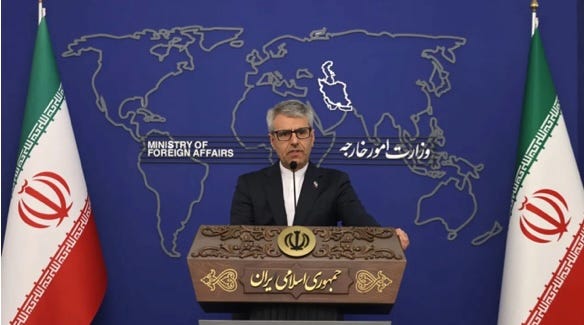
Iranian Foreign Ministry Spokesman Esmail Baghaei
But, In a statement to Iranian media, Esmail Baghaei, the current Spokesperson for the Ministry of Foreign Affairs of Iran, said that although some friendly nations had sent messages indicating that the United States had requested talks, Iran did not respond.
Baghaei additionally noted that the regime’s conditions for an end to the war, as well as Iran’s stance on the Strait of Hormuz must remain unchanged.
US President Trump has also said that he would consider managing the Strait of Hormuz with Iran.
One senior military adviser to the supreme leader said the war will continue until Tehran receives full compensation for damage it has sustained.
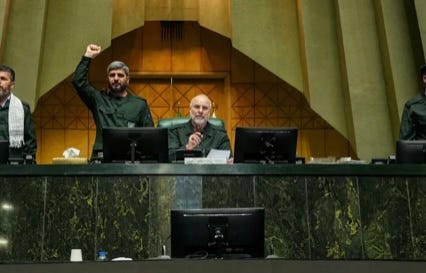
Iranian Parliament Speaker Mohammad-Bagher Ghalibaf (center)
Iranian Parliament Speaker Mohammad-Bagher Ghalibaf looks on as parliament members chant in support of the IRGC while wearing military uniforms in Tehran, Iran
According to the Jerusalem Post, the US is demanding direct talks with Iranian Parliament Speaker Mohammad-Bagher Ghalibaf, a veteran politician and IRGC insider with a deep military pedigree. Ghalibaf has emerged as a central figure in Tehran’s power structure. And is also considered a staunch defender of the IRGC’s regional hegemony.
“He is an ‘insider’ in a way few other politicians are,” said Dr. Raz Zimmt, a senior researcher at the Institute for National Security Studies (INSS) and a leading expert on Iranian affairs.
On March 24th, according to Bloomberg news, Donald Trump’s decision to back down from his threat to destroy Iran’s power infrastructure came after US allies and Gulf countries privately warned the president of the dangers of following through with his threat, according to people familiar with the matter.
Trump’s decision came after some allies cautioned that the war was quickly becoming a disaster. Regional partners told the US that permanent damage to Iranian infrastructure would almost inevitably result in a failed state after the conflict ended, according to the people, who described private conversations on the condition of anonymity.
According to Ynetnews, Israel has been informed of the decision to start negotiations between the US and Iran. Reportedly, Pakistan is now the broker and meetings will take place on Saturday in Islamabad.
Israeli sources put little faith in a positive outcome. Iran is sticking to positions it presented in Geneva before the war began and has now added demands for reparations for damage caused by US and Israeli bombings.
Bergman, writing in the New York Times says as of this moment, all the US and Iran’s efforts are to create a negotiation meeting this week, maybe even two, with the first being between Vice President Vance and Iran’s Foreign Minister Araqchi.
“Is this final? Is there a deal for sure? Absolutely not. It is very difficult to present three sides as winners at the same time in an event, and that is what everyone involved wants.
“The sleight of hand that worked for Trump and Netanyahu last time, saying that the mission was completed and everything was destroyed, will not work again.
“It is not clear in the faltering situation that has arisen what it will be possible to present as a victory. Netanyahu has already changed the goals of the war, he is already preparing for himself the possibility and the alibi of telling the investigation committee that it is the residents of Iran who are to blame for the coup plan failing.”
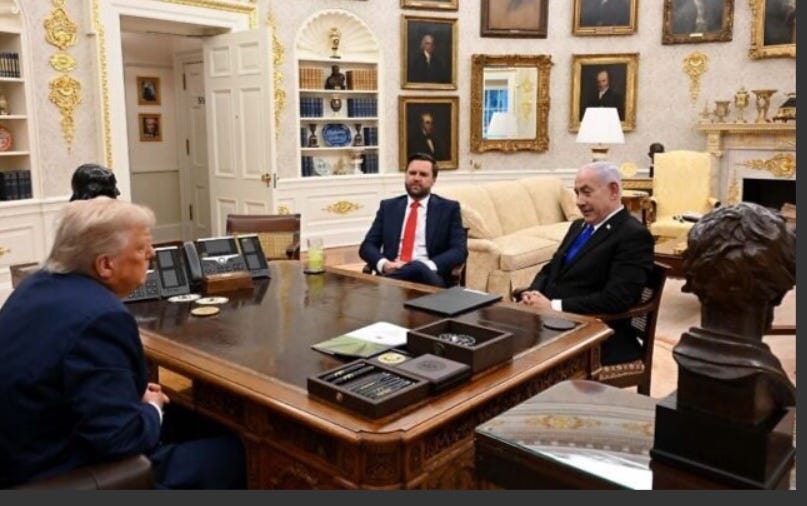
US Pres. Trump (left) VP Vance (center) Israel’s PM Netanyahu (right)
According to CNN, Israel’s Prime Minister Benjamin Netanyahu said Trump believes there is an opportunity to turn military gains into an agreement that would “safeguard our vital interests.” Netanyahu said Israel will continue attacks in Iran and Lebanon.
However, Iranian media reports that these negotiations may be a stalling tactic used to give the 2,500 US marines and three battleships, among them a small aircraft carrier, time to get in position in the Middle East.
Some observers, who were also Trump supporters, agree with the Iranians and refer to the disinformation the US used to stall while positioning two aircraft carriers near Iran back in June. Today, according to the Jerusalem Post, the US has also put the rapid deployment force, the 82nd airborne, on notice.
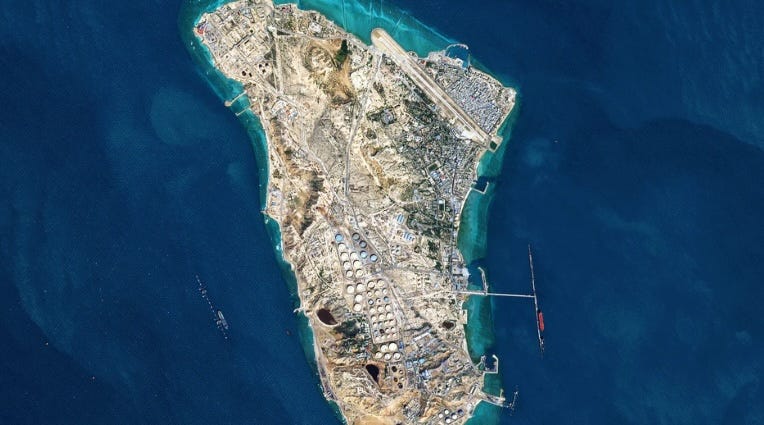
Aerial View of Kharg Island
Military analysts say that if Kharg Island is the goal, then the Marines will first take it and then the 82nd Airborne will fly in to hold it.
BACKGROUND TO THE WAR
According to Ynetnews, the ambitious Mossad plan to spark an uprising in Iran seems to fall short as the war drags on. IDF Chief of Staff Eyal Zamir announced on March 21st that the “War was half over.”
One pundit quipped, “What about the other half?”
While Trump and Netanyahu embraced an optimistic strategy of assassinations and covert efforts to trigger unrest, intelligence officials say fear of Iran’s security forces has so far prevented mass protests or a broader revolt.
US President Trump had hoped an Israeli effort to help trigger internal unrest in Iran would bring about the end of the war, but that hasn’t happened.
Before the war, according to the New York Times, Mossad chief David

Mossad head David (Dedi) Barnea
Barnea presented Prime Minister Benjamin Netanyahu with an assessment that Israel could quickly help stir opposition inside Iran, potentially leading to widespread unrest and even the collapse of the government.
Barnea also discussed the idea with senior Trump administration officials during a visit to Washington in January. Netanyahu backed the approach.
But now, intelligence assessments in both Washington and Jerusalem indicate that Iran’s leadership remains in control, even as it faces mounting pressure.
Officials say fear of the country’s security forces has discouraged large-scale protests, while the likelihood of armed groups entering Iran from neighboring areas remains low for now.
According to CNN, on Thursday, March 22nd, in Qom, Iran publicly hanged 3 protesters linked to January 2026 protests. The three were Saleh Mohammadi (19) a national wrestling champion, Saeed Davoudi (21), and Mehdi Ghasemi.
The Jerusalem Post reported that the men were convicted of “waging war against God” (moharebeh) and killing police officers during protests sparked by economic crisis and anger at clerical rule.
Human rights groups, including Amnesty International, condemned the trials as grossly unfair, citing forced confessions under torture, lack of evidence, and fast-tracked proceedings.
These executions, the first officially tied to the protests, heightened fears of more to come, with dozens of others at imminent risk, including minors.

CENTCOM commander Admiral Bradley Cooper
The move was seen as a warning to dissenters amid ongoing U.S./Israeli military actions against Iran, signaling the regime’s determination to suppress opposition despite international pressure.
Protesters have recently been warned by US Admiral Brad Cooper, head of CENTCOM, (US Central Command) to stay home until they are told it is safe to come out to the streets and protest.
Observers say that the protesters, knowing the dangers of even going outside, have decided to judiciously heed the warnings.
Now, according to Ynetnews, Israel’s Prime Minister Netanyahu has voiced frustration that early expectations of unrest have not materialized.
According to officials, he told colleagues in the early days of the war that time may be limited if Trump chooses to end the conflict before such efforts produce results. Some observers see this simply as Netanyahu once again trying to distance himself from failures and passing the blame onto someone else.
On Monday March 23rd, the Times of Israel reported that there is no expectation of a collapse of the present regime until the war has ended.
According to veteran military correspondent Amir Bar Shalom writing in the Times of Israel, Iran’s Revolutionary Guards are now calling the shots in Tehran.
The Jerusalem Post reports that Iran is taking a hardline approach to the war: No retreat, ever. According to the report Iran is not concerned with the cost of harm to civilian nor to civilian infrastructure.
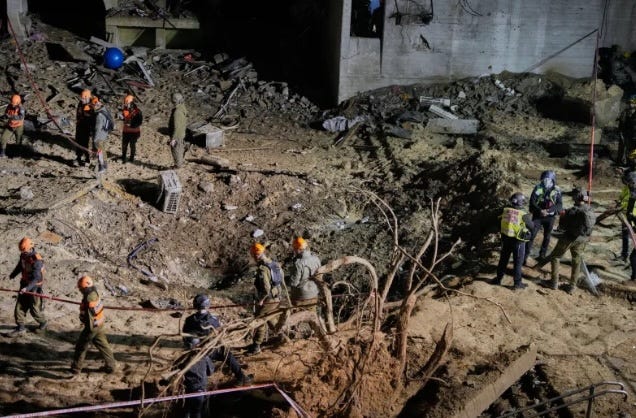
Crater in Arad caused by Iranian missile
Over the weekend, ballistic missiles struck areas in southern Israel, including Arad and Dimona, near the country’s nuclear research center.
Hundreds of Israelis were injured. Illegal cluster bombs were used in the attack.
Meanwhile, Israel attacked Iran’s Natanz nuclear facility. The Iranian state media framing the Arad/Dimona attack as a response to a reported strike on the Natanz nuclear facility.
Iran has steadily fired ballistic missiles and missiles with cluster bombs at Israel. An average of 8 sirens a day blare across Israel sending residents scurrying to their shelters. Many of the injuries are caused by people rushing to their bomb shelters or safe rooms.
So far over 4,000 Israelis have been injured by the rocket attacks from Iran. Experts point out that each volley consists of one one or two missiles, down from the scores and hundreds in earlier attacks.
According to Ynetnews, Israel claims that more that 15,000 Iranian targets have been hit by the US and Israel, with over 50 senior Iranian officials killed, while causing major damage to Iranian missile, air defenses, naval capabilities, including the Iranian gas infrastructure, 100 anti-aircraft batteries and 120 radar systems. Reportedly, the Israeli/US attacks have destroyed 2/3rds of Iran’s military industry.
US Central Command (CENTCOM) is involved on the Eastern and Southern parts of Iran with 50,000 US troops taking part.
The Jerusalem Post reports that while Iran has been set back years there is nothing stopping the Chinese from coming and and rebuilding everything again.

Iranian Supreme Leader Ayatollah Mojtaba Khamenei
The new Iranian Supreme Leader Majtaba Khamanei has not been seen since before his father’s death nearly three weeks ago. In the interim, according to commentator Bar Shalom, decisions are now mainly being made on a hardline axis, between parliament speaker Mohammad Bagher Ghalibaf and IRGC commander Ahmad Vahidi.
“That hawkish line can be seen in Iran’s continuing attacks on the Gulf states and in the helplessness of relatively less extreme government figures, some of whom are trying to find a diplomatic path to end the war.”
Bar Shalom, and other sources, report that “…on Saturday, March 21st, Iranian President Masoud Pezeshkian spoke with Indian Prime Minister Narendra Modi and proposed that BRICS (the economic bloc that includes Brazil, China, India, Russia, the United Arab Emirates, and South Africa) begin negotiations with the US and Israel to halt the fighting.”
According to Ynetnews, Israeli officials say future strikes against Iran are likely unavoidable if Tehran resumes ballistic missile production or advances toward nuclear weapons capability.
However, Bar Shalom says that the IRGC still believes it is strong enough to stand up to the US and Israeli attacks. But, says Bar Shalom, “… all sides lined up against Iran agree that ending the war without removing the enriched material from Iran would be akin to leaving smoldering embers, and that if the current regime, regardless of who is at its helm, remains in place, efforts to break out to a nuclear bomb will be significantly accelerated.”
Iran recently fired two multi-stage rocket, based on the Russian R-27, that flew over 2000 miles (@4,000 km) aimed at the US/UK air force base on Diego Gracia, in the Indian Ocean jwhere the B-2 bombers are based, but hit the island. One rocket failed in flight, the other was intercepted and shot down.
Israel’s chief of staff Eyal Zamir said Israel was aware of the rocket’s range.

3-D printed shoulder-launched missile
But what worries experts is a new shoulder-fired rocket that can be produced for @$100 using a 3-D printer. According to Ynetnews, Alisher Khojayev, an 18-year-old undergraduate computer science student at Los Angeles Valley College, based in California and also a freelance engineer, has published a prototype of a shoulder-launched guided missile on GitHub, built with a 3D printer and costing less than $100. The system combines GPS, a simple flight computer, and a network of cameras that locate targets in the air.
A comparable US military system like the Stinger missile costs the American taxpayer about $480,000 per unit. Or the US Air Force’s “cheap missile” project (Counter-Air Missile Program or CAMP), launched with the aim of reducing mass production costs, is targeting a price tag of several hundred thousand dollars.
Meanwhile, the real testing ground is now in Ukraine, which has been at war with Russia for four years. Recently, the Ukrainian SkyFall company unveiled the $100 P1-Sun, a 300 mph (450 km/h) 3-D printed interceptor drone designed to shoot down Iranian Shahid cruise missiles and drones.
This, while Western powers boast sophisticated interception systems, like the Iron Dome, the Arrow 3, and the US Thaad, that cost millions to billions of dollars to purchase.
Each interceptor missile fired from the Iron Dome costs $70,000–100,000 per interceptor. Arrow-3 interceptors cost approximately $4 million each, the US Thaad interceptor’s official cost is approximately $12.7 million per unit.
Experts say that these new 3-D devices are awake-up call for the defense industry where the competition is no longer just about who has the fastest missile, but who has the fastest and most successful 3-D printer, and the smartest code.
Ynetnews says that for Israel, which is at the forefront of technology, the threat is clear: if any armed group can produce shoulder-launched missiles for the cost of a family meal, freedom of air operation will face an unprecedented challenge.
Meanwhile, Iran launched multiple missile attacks on Israel in March 2026. Hundreds of ballistic missiles, half cluster bombs, were fired from Iran, according to data from the Institute for National Security Studies at Tel Aviv University.
These attacks occurred in waves, including a significant salvo on March 16 that prompted sirens across central and northern Israel.
Israel intercepted most of these projectiles using its multi-layered air defense systems, including Iron Dome, David’s Sling, and Arrow.
Despite the large number of incoming missiles, Israel’s air defenses intercepted the majority, though some projectiles penetrated, causing damage and injuries.
However, the army spokesman told an Israel TV audience on Sunday March 22nd that the air defenses intercept 92% of the rockets fired at Israel. Still, that leaves 8% said analysts on Israel TV.
One tragic example are the missiles that slipped through Israel’s defense on Saturday March 21st and landed in the southern Israeli towns of Dimona and Arad. One bomb carried a half-ton warhead, the other cluster bombs. 16 buildings were damaged and over 200 Israelis injured.
According to Channel 1 Kan TV, Iran has fired over 400 cluster bombs at Israel.
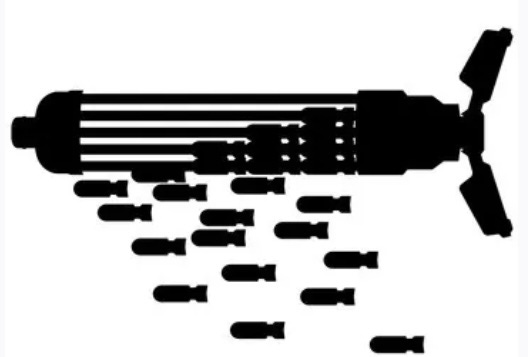
Diagram example of cluster bomb
The exact total number of those missiles that have landed on Israeli territory is not specified in the available data, but their impact was limited due to the effectiveness of Israel’s air defense systems.
As a precaution against a possible rocket strike on an airplane, Israel has cut back traffic to Ben Gurion Airport. Only one plane an hour is now allowed in, Outgoing flights are limited to 50 people.
El Al and Arkia airlines are the only airlines flying into and out of Israel. Almost all of the major airlines have cancelled all flights until the end of the May, some longer.
David Horowitz, editor of the Times of Israel ,wrote that Israel must stay the course and not let up on the attacks on Iran until the present Iranian regime is gone.
Channel 12TV’s military correspondent Nir Dvori said that he expects the war to last until well after Passover.
One military analyst said that should the war with Iran end with Iran still having a nuclear capability, then the war was for nothing.
Gaza
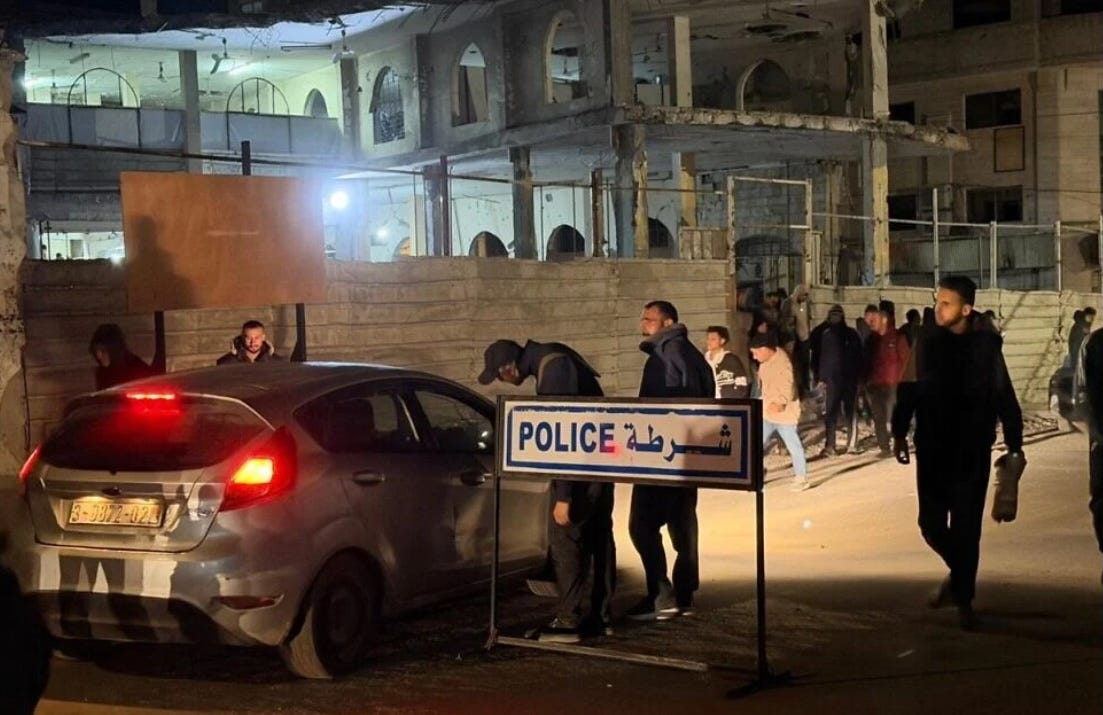
Hamas militia at Gaza checkpoint
As the Iran war diverts attention from Gaza, Hamas police have openly tightened the groups grip on Gaza, according to the Times of Israel. Hamas’ militia (police) patrol without masks and are now in control of food prices amid the shortage of supplies entering the strip.
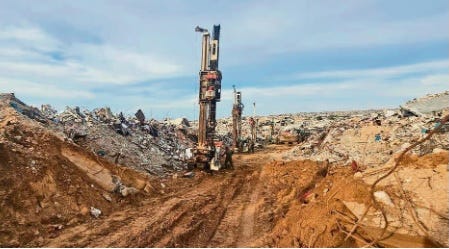
IDF drilling for Hamas tunnels in Gaza
And according to Ynetnews, Israel’s drilling project to map Gaza tunnels has showed down after dense network of tunnels was found.
Meanwhile, Israeli officials have warned Hamas retains operational control in the central refugee camps as Israel shifts military attention to Iran.
North
According to Ynetnews, on March 24th, one woman was killed in a relentless Hezbollah rocket attack on the Galilee. Two residents of Safed were lightly injured by glass shards.
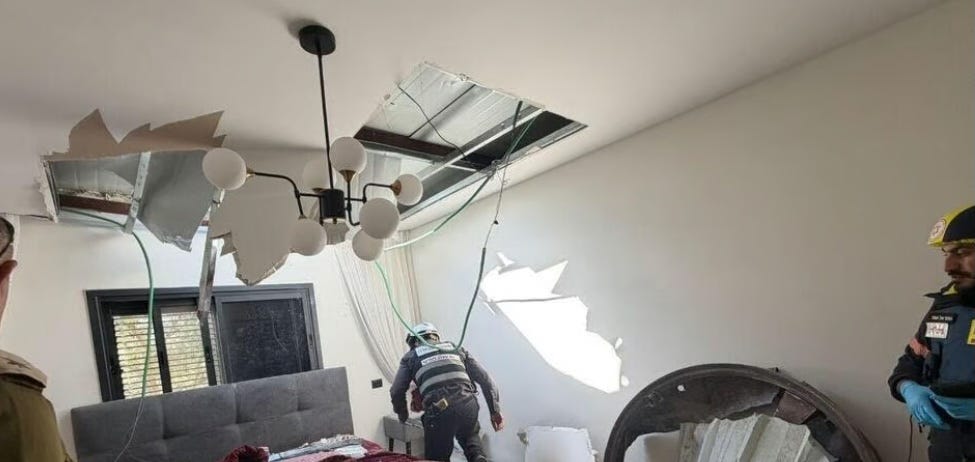
Rocket damage in northern Israel
Also on Tuesday March 24th, the Lebanese government declared Iran’s ambassador in Beirut persona non grata and order him to leave the country by Sunday.
Hezbollah on Tuesday said it “condemns and rejects” the decision, calling it “baseless” and accusing Lebanese officials of yielding to external pressure.
“This reckless and disgraceful step does not serve Lebanon’s national interests, its sovereignty or its unity,” the group said. “It represents clear submission to external dictates and weakens the Lebanese state.”
Meanwhile, the IDF is continuing operations in southern Lebanon, aiming to push Hezbollah operatives farther from the border and limit their ability to carry out attacks. Northern Command is currently conducting what officials describe as a controlled defensive campaign, relying on targeted raids rather than a broad ground offensive.
Ground forces, including units from the Golani Brigade, are operating in the first line of villages near the border. Troops are demolishing structures used for military purposes, searching for weapons and clearing areas used for launching projectiles toward Israel.
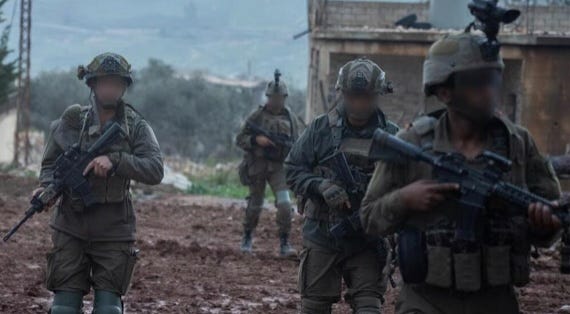
IDF’s Golani Brigade troops operate in southern Lebanon
According to the military, Hezbollah operatives have largely withdrawn from frontline positions and are now entrenched in deeper defensive zones inside Lebanon, where they are preparing for potential clashes with Israeli forces.
Israel’s Chief of Staff Eyal Zamir has said that the operation in Lebanon has just started.
Israel has sent in two battalions of soldiers to confront Hezbollah. The plan is to push them back beyond the Litani river and create a buffer zone between the Israeli border and the Litani.
Israeli troops are clearing out Hamas strongholds in southern Lebanon. Attacking weapons supplies and rocket positions. Experts say that Israel was concerned that Hamas would mount an Oct 7th surprise attack on Israel as Hamas did.
Israeli troops encountered a force of an estimated 1,000 Hezbollah soldiers. 7 IDF soldiers were wounded in the battle.
Most of the Israeli residents of the north left their homes at the outbreak of the Oct 7th war when Hezbollah began to pound the north with missiles.
About a month before the outbreak of the Iran war residents of the north began returning to their homes. Now they are again under relentless rocket fire and unnerving sirens.
According to Nir Dvori, military correspondent for Channel 12TV, residents along the northern border were told by the IDF to stay. To wait it out.
But some residents are starting to leave. Some claim they were promised security if they returned. And they returned. Some said they hope the security comes soon.
One restaurant owner in Kyriat Shmona told Reshet Bet radio that he was born and raised in Kyriat Shmona a. He owned a restaurant that he said once had a hundred customers a day but was now down to 30.
“Can you make a living?” the reporter asked him in a telephone interview. “No,” he quickly answered. “But I’m not going to be driven from my home again.” He said he was taking out loans and running up his bank overdraft to pay the bills.
On March 19th, according to ynetnews, Iran struck an Israeli oil refinery in the Haifa. However Israeli sources say the damage was not significant.
Meanwhile, Hezbollah has joined the fighting, riddling Israel’s north with a relentless missile attack.
Hezbollah, the Iran-backed terrorist group in Lebanon, also launched a barrage of over 1,000 shorter-range rockets and drones toward northern Israel during March 2026, with one major attack on March 11 involving around 100 rockets.
According to the Washington D.C. based Institute for the Study of War, Israeli media reported that Hezbollah is dispersing its short-range rockets across Lebanon, which makes them more difficult for Israeli intelligence agencies to track.
The Institute reported that the IDF has noted that this Hezbollah tactic has diminished the group’s ability to launch large rocket barrages.
According to the Institute, the IDF also estimates that Hezbollah has hundreds of Radwan Force fighters operating in small cells in approximately 200 villages south of the Litani River.
The Radwan Force is Hezbollah’s elite special operations unit that Hezbollah, observed the Institute, with Iranian support, built to conduct major ground attacks into Israel.
According to the Institute, Israeli media, citing the IDF, noted that Hezbollah fighters are not engaging in close combat with the IDF and are rather dispersed among Lebanese villages and launching attacks on Israeli forces from these villages.
Hezbollah’s claimed attacks are consistent with this Israeli media report. Hezbollah’s claimed direct engagements with Israeli forces suggest that Hezbollah fighters are only directly engaging Israeli forces after Israeli forces attempt to advance.
The Institute also reported on sophisticated cyber attacks. According to the Institute Lebanese media reported that an Iranian-affiliated group briefly hacked the Lebanese foreign affairs and information ministries’ websites on March 18.
The Fatemiyoun Electronic Team claimed responsibility for the hacks.
The Fatemiyoun Electronic Team is a pro-Iranian hacktivist group that is reportedly controlled by Iranian-backed Iraqi militia Kataib Hezbollah and has previously conducted cyberattacks in support of Iran.
The IDF reported that it has struck approximately 2,000 Hezbollah targets in Lebanon, including 100 high-value targets and 220 time-sensitive targets, with over 2,200 munitions and 1,000 sorties since March 2.
The IDF has also killed at least 500 Hezbollah fighters since March 2.The IDF reportedly struck a building in Beirut that was owned by al Boyan CEO Hussein Ali Salah al Moussawi on March 18.
Al Boyan for Engineering and Contracting Company is one of Hezbollah’s construction organizations.[117] The IDF reportedly struck the Qannayat bridge in southern Lebanon on March 19.
While reports of Israel striking critical civilian infrastructure in Lebanon persist, but analysts say that Israel is trying to avoid civilian damage in order to encourage the Lebanese government to rein in Hezbollah and active the ceasefire.
According to the Times of Israel, Hezbollah has said they are ready for a “long confrontation.”
West Bank
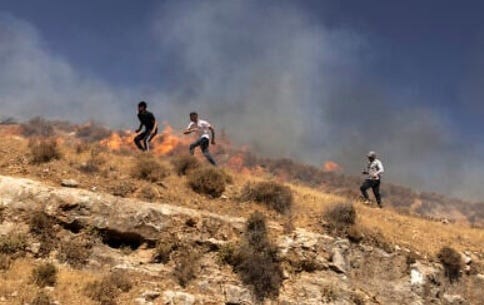
Jewish terrorism continues on the West Bank.
According to Ynetnews on Monday March 23rd, IDF soldiers overnight arrested four Palestinians, residents of Tuqu’ south of Bethlehem, on suspicion of involvement in stone-throwing and hurling firebombs at vehicles and security forces. The four were transferred to police for interrogation.
Ynetnews reports that over 20 incidents of “Nationalist Crime Incidents” against Palestinians have been perpetrated in the West Bank (Judea and Samaria) since the beginning of the year.
These incidents include roadblocks, violent clashes, stone-throwing, arson attacks, attacks against Palestinian vehicles. 11 Palestinians have been injured.
According to the Times of Israel on March 20th, “Jewish settler extremists” drove an entire Palestinian village of Khallet a Sidra into exile. Palestinians say that the IDF prevented the Palestinians from returning to their homes after the attack.
Settlers also attacked the Palestinian village of Mukhmos after an illegal settler outpost was destroyed by the IDF. One Palestinian reportedly died of a heart attack during the settler attack.
Some critics say that Minister of National Security, Itamar Ben Gvir, who supported the late ultra-right Rabbi Meir Kahane’s view of expelling all Palestinians from the West Bank, is allowing the Jewish settlers to carry out Kahane’s policies.
On March 22nd, according to Ynetnews, Jewish settlers attempted to set fire to a medical clinic and vehicles in a West Bank Village.
According to theYnetnews, seven Palestinians have been killed so far by Jewish nationalists.
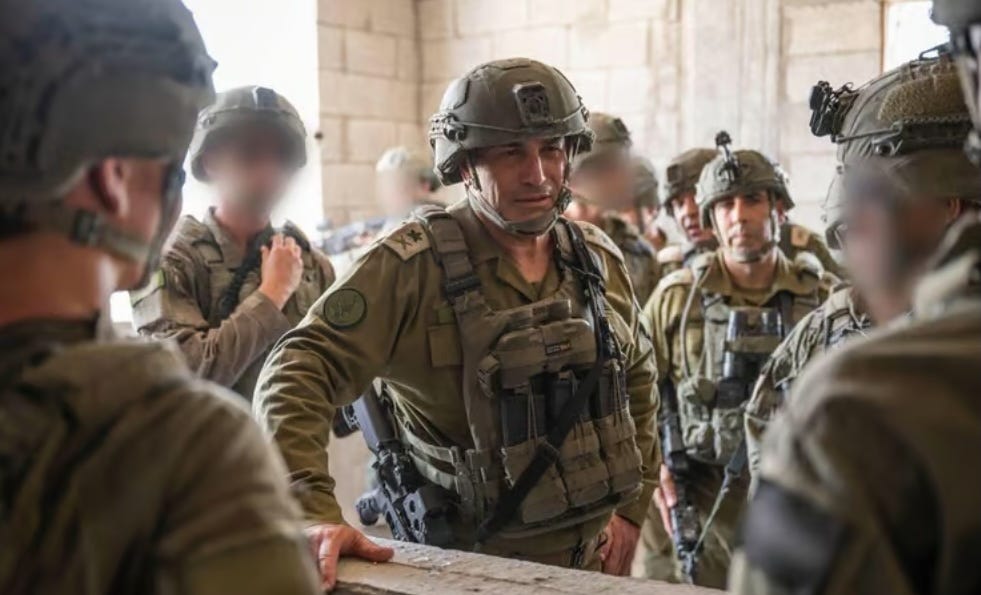
Israel’s Chief of Staff Eyal Zamir (center)
Meanwhile, IDF Chief of Staff Eyal Zamir told the media that settler violence was ‘Unacceptable’ and results in ‘Extraordinary’ strategic damage during a time of war.
According to CNN on Tuesday, March 24th, Israel was diverting a combat battalion from its northern border with Lebanon to the occupied West Bank amid a wartime surge in settler violence against Palestinians, according to an Israeli military official. Yesh Din, an Israeli human rights group, said there has been an average of 10 settler attacks per day on Palestinians since the start of March.
Meanwhile, a fourth Palestinian woman, who was pregnant, died as a result of an Iranian missile attack on Thursday March 19th. Experts say the missile apparently veered off course.
Another missile also struck just a few hundred yards from the Al Aksa Mosque in Jerusalem. No damage was reported. The missile fell into the open area of the Jerusalem outdoor concert site at Sultan’s Pool.
Red Sea
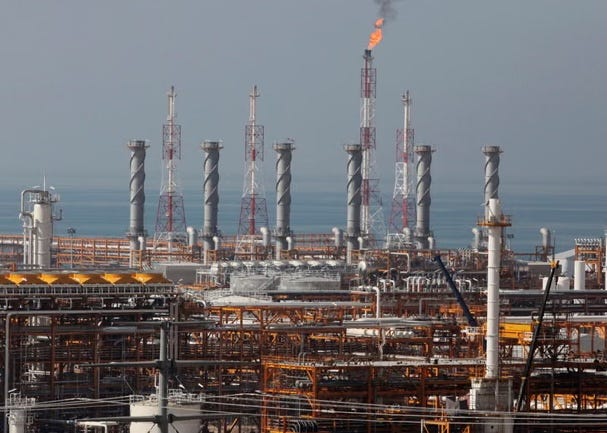
Iran’s South Pars gas field
On March 18th, according to the Jerusalem Post, Israel launched an attack on Iran’s South Pars gas field, the world’s largest natural gas reserve, prompting a sharp escalation in the Middle East conflict.
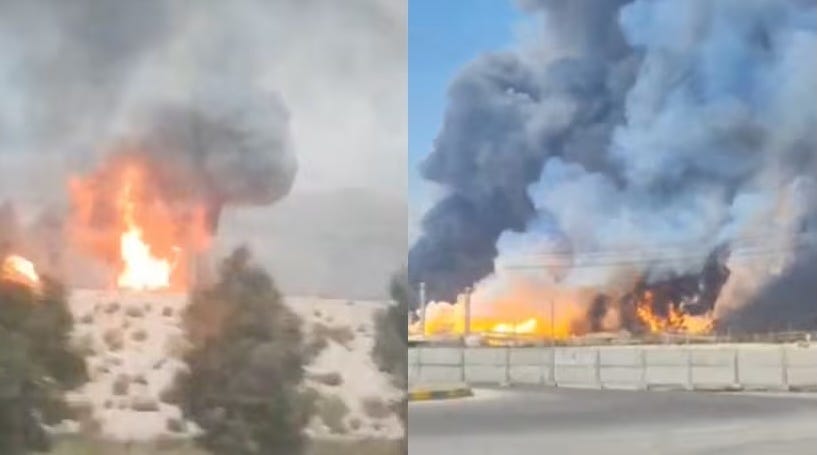
Iran’s South Pars gas field after Israeli strike
In response, Iran retaliated by striking energy facilities in Qatar, Saudi Arabia, and the UAE, causing extensive damage to Qatar’s Ras Laffan LNG hub.
Iran attacked the Aramco site in Saudi Arabia. In response the Saudis said they any trust with Iran was completely shattered.
Saudi Arabia said it intercepted and destroyed four ballistic missiles launched toward Riyadh on Wednesday and an attempted drone attack on a gas facility in its east.
On Thursday, Iran again attacked Qatar’ gas facilities, and its missiles also targeted the Saudi capital.
On March Friday, March 20th, a Kuwait oil refinery caught fire after being struck by an Iranian missile.
QatarEnergy reported “sizable fires” and extensive damage at several of its liquefied natural gas facilities hit by missile attacks early on Thursday.
Iran has threatened to close the Strait of Hormuz should the US attack any of its energy producing sites or infrastructure. Iran has also threatened to hit Israel’s electric grid should Iran be attacked.
Iran has already used a mix of conventional and asymmetric tactics to sharply reduce shipping traffic through the strait, from roughly 130 tankers per day under normal conditions to minimal levels now. U.S. strikes have targeted Iranian missile launchers, mine-laying vessels and fast boats in the area, but have not restored maritime traffic.
Israeli officials say the complexity of securing the strait is evident in what they describe as U.S. hesitation to fully commit naval forces, as well as efforts to involve European allies or China.
According to the IDF Spokesman’s office, the IDF has hit Iranian ships in the strait of Hormuz carrying weapons and supplies. But Iran is still in control of the strait.
According to Ynetnews, quoting the Washington Post, US President Trumps endgame for the Iran war runs through the Strait of Hormuz.
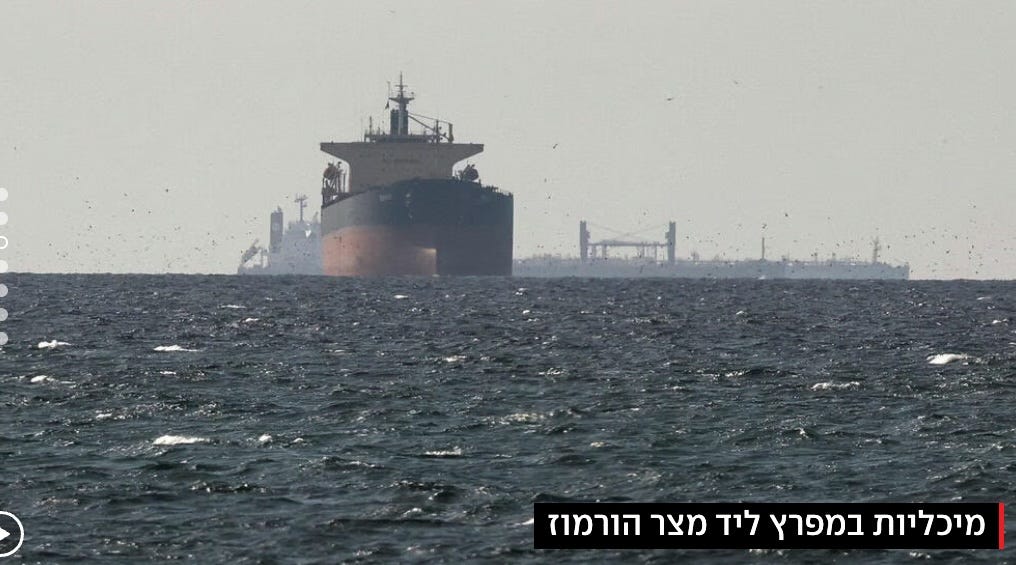
Strait of Hormuz
Officials now assess that breaking Iran’s grip on the strait could allow Trump to declare victory while stripping Tehran of one of its most powerful deterrents.
According to observers, as far back as 1988 Trump has said that by seizing Kharg Island, Iran’s main oil expert terminal, Iran would be choked off economically and collapse. This while keeping the strait of Hormuz open.
The shift in focus, according to the Washington Post, is highlighted by the fact that the US is deploying additional forces to the region.
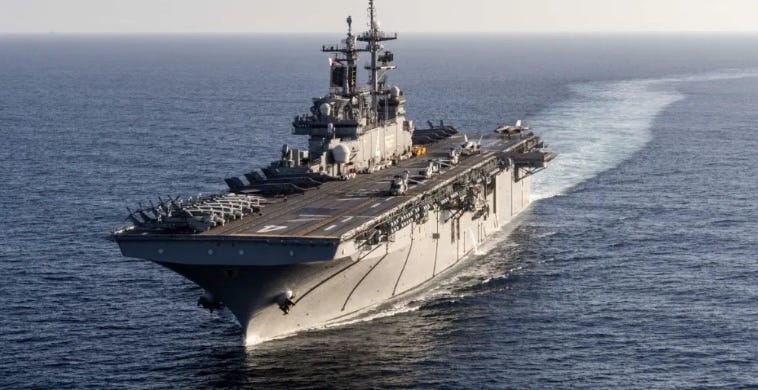
USS Boxer small aircraft carrier
According to ABC-TV, the 11th Marine Expeditionary Unit (MEU) is aboard the USS Boxer, a small aircraft carrier, the USS Comstock and the USS Portland, both amphibious landing vessels, carrying 2,200 Marines along with 2,000 sailors.
Included in the MEU: ground forces, a logistical element and aviation units that include F-35 fighter jets, MV-22 Ospreys and attack helicopters.
Experts speculate these ships might be used to seize Kharg Island in the Persian Gulf, crucial to Iran’s oil trade, or carry out raids on the Iranian shoreline around the Strait of Hormuz.
Israeli officials say that any operation to secure the waterway would likely fall primarily on the United States and could take weeks, exposing forces to mines, drones and coastal attacks.
One Israeli official said, “These Marines are not coming as decoration.”
Also, according to AP, Israel hacked Iran’s ubiquitous security cameras used to find demonstrators to assassinate former Supreme Leader Ayatollah Ali Khamenei.
Reportedly, Iran installed hundreds of millions of cameras above shops, in homes and on street corners across the city, many connected to the internet and poorly secured. Recent advances in artificial intelligence have enabled militaries and intelligence agencies to sift through vast amounts of surveillance footage and identify targets. Israel used these cameras to track down Ayatollah Ali Khamenei and kill him.
AP reported that “All the cameras at our intersections are in the hands of Israel,” Mahmoud Nabavian, deputy chairman of the Iranian parliament’s national security committee, told Iranian media in September. “Everything on the internet is in their hands… if we move, they will find out.”
Antisemitism
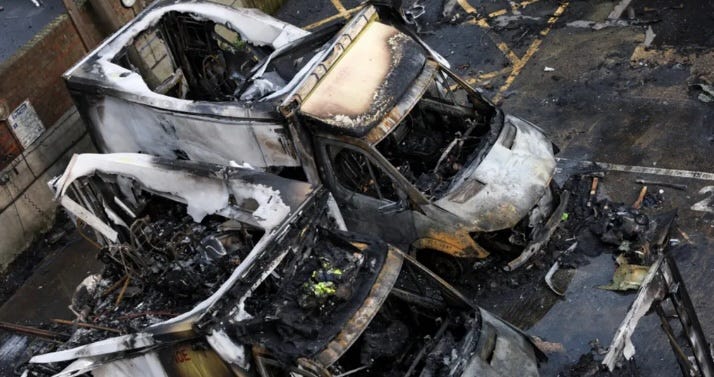
Ambulances on fire in Golders Green, London
Four Hatzelah ambulances were firebombed in north London’s heavily Jewish Golders Green neighborhood during the night of March 22nd. The ambulances were parked in front of a synagogue.
In NYC, according to the Jerusalem Post, NYC Mayor Zohran Mamdani hosted pro-Palestinian activist Mahmoud Khalil and his family for an iftar dinner at Gracie Mansion during Ramadan, marking approximately one year since Khalil’s detention by ICE over his role in pro-Palestinian protests at Columbia University
Khalila is known to have justified the Oct 7th massacre of Jewish residents along the Gaza border when 1,200 were massacred by Hamas terrorists, thousands injured and 251 taken prisoner.
Also, according to the Times of Israel, the two slain brothers of 41-year-old Ayman Mohamed Ghazali, the terrorist who attacked the Temple Israel synagogue in West Bloomfield, Michigan were part of the Hezbollah rocket unit. Both were killed by an IDF attack.
According to the Jerusalem Post, Ghazali attacked the synagogue in revenge against the Jewish community that supported Israel. Ghazali was a naturalized American citizen who lived in the heavily populated Muslim town of Dearborn, Michigan.
According to the Australian Jewish Independent, Jewish communities around the world are on high alert following a wave of violent attacks on Jewish sites in the past week.
On March 9, a synagogue in the Belgian city of Liege was hit by an explosion in the early morning, in what authorities have called a targeted antisemitic attack.
No injuries were reported as a result of the explosion, which blew out the windows of the synagogue as well as those of a building across the street.
On Friday March 13th, an explosion damaged a Jewish school in Amsterdam, in what authorities say was a deliberate attack targeting the Jewish community.
On the same day in Rotterdam, Dutch police said four men, from 17-19 years of age, were arrested after an arson attack on a synagogue in the city’s centre. No one was injured from the fire, which was caused by an explosion in the early morning.
Three synagogues in the Toronto area, Canada, were targeted by gunfire within about one week in early March 2026. About five days later, during the night of March 6-7, two additional synagogues in the Toronto area , Beth Avraham Yoseph of Toronto and Shaarei Shomayim, were also struck by gunfire within roughly 20 to 30 minutes of each other. These incidents also caused property damage but no injuries.
According to the JTA (Jewish Telegraph Agency) “We are in the midst of the most elevated and complex threat environment we have seen that the Jewish communities and the country has seen in modern history,” said Kerry Sieger, chief of threat management and information sharing for the Secure Community Network, a Jewish security organization.
Politics

National Security Minister Itamar Ben Gvir
According to the Times of Israel, the High Court postponed a hearing on the petition by Israel’s attorney General Gali Baharav-Miara for the government to fire National Security Minister Itamar Ben Gvir for abuse of power.
And, according to the Jerusalem Post, former Gen. Yair Golan, head of the Democrats party, has issued a ‘severe warning’ to PM Netanyahu criticizing his military strategy in Lebanon.
In recent polls, Likud (Netanyahu) leads in several polls conducted around March 19, 2026, with projections ranging from 25 to 35 seats, showing a strong performance for the right-wing party.
The Bennett 2026 party, led by former Prime Minister Naftali Bennett, is closely trailing, with seat estimates between 19 and 23, positioning it as a major contender.
Opposition bloc, which includes Bennett 2026, Yesh Atid (Lapid), Yisrael Beiteinu (Lieberman), Democrats (Golan), Yashar (Eisenkot), and others, is projected to collectively secure 57–60 seats, nearing but not consistently surpassing the 61-seat majority threshold.
The Arab Bloc, primarily the Joint List, is projected to win 11–16 seats, and when aligned with the opposition, pushes the total to 65 seats in some polls.
Netanyahu’s bloc, comprising Likud, Shas, Otzma Yehudit, United Torah Judaism, and Religious Zionism, ranges between 50–54 seats, falling short of a majority.
Some polls, especially those from the ultra-right Channel 14 (Filber/Direct Polls), show a higher projection of 64–66 seats for the pro-Netanyahu bloc, though these are viewed with caution due to potential bias.
Despite fluctuations, no bloc has secured a clear path to a governing majority, indicating a political deadlock as of mid-March 2026. The last deadlock resulted in five elections before the Likud coalition finally won by a one-seat margin.
According to pundits, the fragmentation of smaller parties and inconsistent alignment of Arab parties contribute to the ongoing uncertainty.
A recent poll showed that the Yashar (straight) party’s Gen (ret.) Gadi Eisenkott was more popular to lead the country than former Prime Minister Neftali Bennett.
Editorial
A spinmeister supreme knows how to sell a tragedy as a miracle.
And, there are those who firmly believe that fate dictates and even over rides free will. Everything happens for a reason.
The ’48 war brought about the creation of the state of Israel.
The ’73 war brought about the peace treaty with Egypt.
The Oct 7th massacre brought about the end, one hopes, of Hamas, the terrorist organization that invaded Israel killing 1200, wounding thousands and taking 251 prisoners, many held for nearly two years in Gaza tunnels.
But, on March 22, 2026 Iranian Ghadr missiles avoided Israel’s air defense systems and wrecked havoc on the southern towns of Arad and Dimona, two small development towns near Israel’s nuclear reactor.
Pundits believe the Iranian rockets were aiming at the well protected reactor and ask why there was no adequate air defense to protect the nearby cities.
A security source told Ynetnews that “…“Interception attempts were made against two targets at Dimona and Arad, which were unsuccessful, both in terms of professional conditions and in terms of systems integration that this time did not succeed.”
This was explained by security sources who noted that the enemy is learning and advancing, and is constantly making changes and adapting accordingly.
The security sources clarified that these tragedy in Arad and Dimona were not a systemic failure, but rather a chain of malfunctions that led to these results. The sources also noted that so far more than 400 missiles have been launched from Iran, with a more than 92 percent success in interception.
According to Channel 1 Kan TV’s military correspondent Itai Blumenthal, Israel’s defense system is essentially one man who sits in front of a screen and decides which air defense systems to employ against incoming missiles. He, or she, then takes into account that there are places in Israel that are low risk so the air defenses are not used.
Gen (ret.) Alon Biton, former head of air defense, said that the attacks on Arad and Dimona was a failure. It is cheaper to shoot a missile for defense than to rebuild he said. And reiterated that 92 percent is a very impressive success rate.
When he was asked about the Iranian’s capability to fire missiles 4,000 km, he said that Iran has multi stage missiles that can get even farther than 4,000.
Israel’s Chief of Staff Eyal Zamir told the Israeli media in a press conference that, “Iran fired a rocket that travelled 4,000 km to Diego Gracia. This means that not only Israel but Europe are open targets.”
On Sunday March 22nd at 15:15 sirens sounded again in the center of the country. The Ghadr missiles were intercepted by US manned THAAD missiles. Some damage but no injuries were reported.
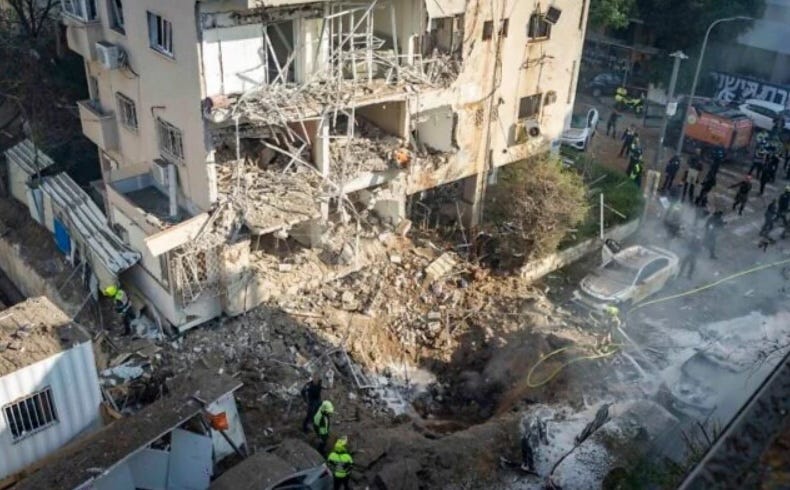
Rocket damage in central Tel Aviv
On Tuesday March 24th a missile landed in central Tel Aviv
Ynetnews also reported that “… Incoming Iranian missiles were shot at with Arrow 3 over Jordan, but missed either through technical failure of the complex system, or human error….and a last attempt to intercept the warhead using the Iron Dome air defense system, which is designed primarily for short-range threats also failed. Analysts said that the Iron Dome interceptor missile appears slower than the ballistic warhead, which falls at about Mach 5, roughly five times the speed of sound, or more.
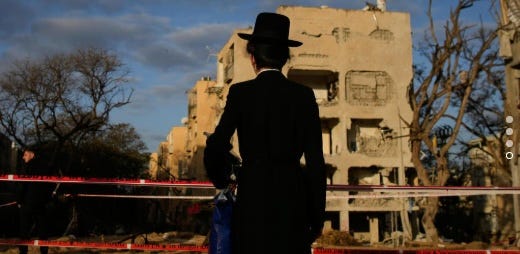
Arad resident looking at damaged building
In the case of the Arad/Dimona attacks, the result was disastrous. Estimates that nearly 200 people were injured in the two attacks. Some seriously.
According to the Times of Israel, 36 people, 19 of them children, were still hospitalized from direct hits in Dimona and Arad.
Reportedly, two types of rockets were used. The illegal cluster bombs that released scores of 5kg sub-rockets with 5kg warheads. And the nearly 500kg warheads on the standard Iranian missile.
According to Reshet Bet, Kan Broadcasting’s military correspondent Itai Blumenthal reported that massive number of injuries occurred because people were not in their bomb shelters.
Blumenthal said that Arad had never been hit before and people were complacent about the air raids. Many residents were in the streets, some hoping to photograph the rockets.
Both Arad and Dimona had older four-story buildings, each with a bomb shelter in the basement area. But, said one observer, since no missiles had ever hit the area, few people heeded the sirens and entered the bomb shelters.
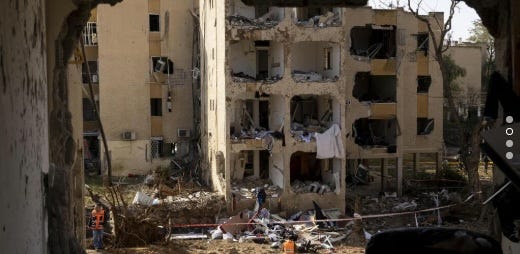
Rocket damage to building in Arad
Thus the missiles caught them aware but completely exposed. 16 buildings were hit. Shrapnel ripped into crowds outside hoping to get a photograph of the air defense missiles intercepting the Iranian missiles. Rather, some got a close up of a rocket too near them to dodge and suffered for it.
Then came the spinmeister, Prime Minister Benjamin Netanyahu. According to Elisha Ben Kimon and Itamar Eichner, writing in Ynetnews, Netanyahu visited the scene of the Arad hit.
“A miracle happened here,” said Netanyahu. “…no one was killed. But we don’t want to rely only on a miracle. There were ten whole minutes from the warning until the missile fell. The missile fell here, between the buildings.”
Netanyahu added: “If everyone would have entered the protected areas at that time, the shelters that are under every house here, no one would have been hurt. No one would have been injured either.”
In all, five missiles carrying conventional warheads with hundreds of kilograms of explosives have struck populated areas in Israel, causing extensive damage in four cases. There have also been more than two dozen incidents of missiles carrying cluster bomb warheads hitting populated areas, with over 100 separate impact sites.
And the Prime Minister slid away from responsibility. In the north there was a glaring lack of bomb shelters for the population. Residents say they have been promised bomb shelters for years but none arrived. The money to renovate apartment buildings to accommodate bomb shelters was never found.
When the government finally decides to assemble a state commission on the background of the Iran War, pundits wonder if PM Netanyahu will again manage to slip away from responsibility and lay the blame on someone, anyone, else as he is doing on the Oct 7th tragedy.
Nor will he admit that during his years as Prime Minister he was responsible for not insuring the residents of the north were protected by safe rooms and bomb shelters.
Meanwhile, the sirens wail. Nerves are frayed. Parents are up in the middle of the night herding their children into safe rooms. Elderly Israelis have trouble getting down four flights of stairs and stay under a nearby stair case.
Many Israelis are injured rushing to the nearby bomb shelter or safe room. Pavlov’s conditioning is at a high peak. Pundits say that the Iranian strategy of psychological warfare is working. A loud bang, once ignored, now startles people. And the jets are flying nearly constantly overhead heading to Lebanon or Iran.
Israel justifiably claims great accomplishments in the Iran war. The top leadership of Iran has been decimated. Those left are staying out of sight.
The same is true of the other front in Lebanon.
Still, the sirens are blaring, the missiles are falling, the Israelis are scurrying for cover. So, asks one pundit, is the cup half-full? With Israel close to victory? Or half-empty, facing a stalemate on two fronts? Time will tell.
.